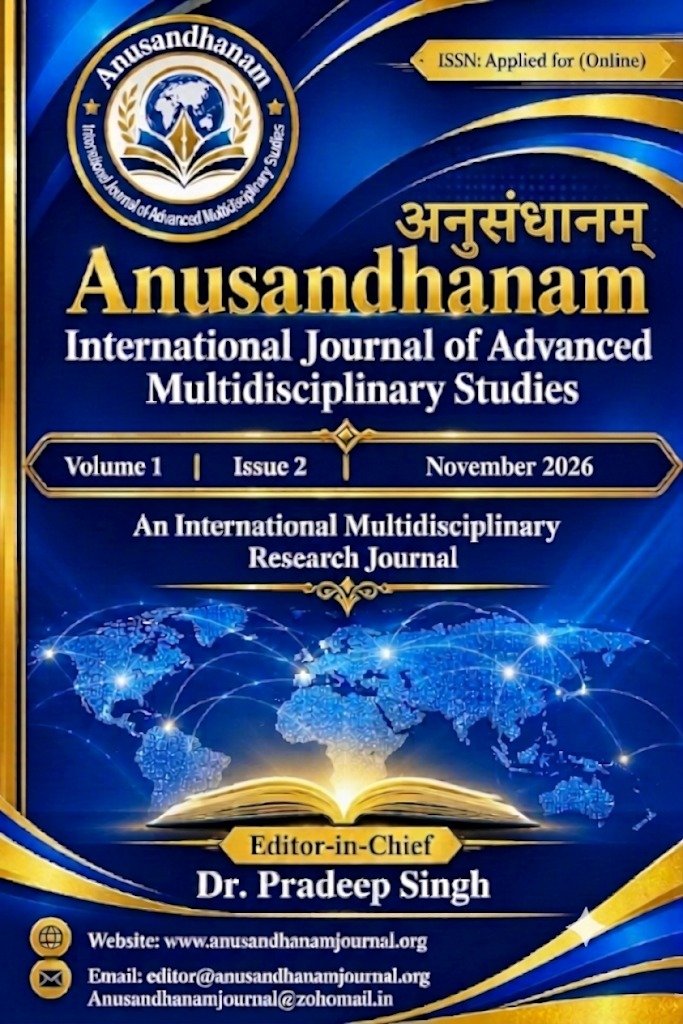
Vol. 1 No. 2 (2026): Auditing Group-Level Error in Student Performance Prediction: Reweighting, Uncertainty and a Bharatiya Framework for Trustworthy Educational AI, November, 2026, pg , 1-20
Machine-learning models used in schools and universities are usually judged by overall error, for example mean absolute error (MAE) or R2. A model can look accurate on average and still make much larger errors for some groups of students, and the average hides it. This paper examines that gap with the UCI Student Performance data (Cortez, 2008), a public benchmark of 395 mathematics students from two Portuguese secondary schools. Linear Regression, Random Forest and XGBoost were trained to predict the final grade (G3) and were evaluated on a held-out set of 79 students and by five-fold cross-validation. Error disparity was measured across sex and home address with group-wise MAE, performance disparity (PD), the standard deviation of group MAEs, and their coefficient of variation. Random Forest was the most accurate model (test MAE = 1.165, R2 = 0.820), yet it also had the largest sex-based disparity (PD = 0.468) and the smallest address-based disparity (PD = 0.057). Inverse-frequency reweighting over the four sex–address groups lowered sex-based PD for all three models, by 3.5% to 28.7%, without a consistent loss of accuracy. Paired bootstrap intervals on the small test set were wide, however, and every interval for the change in PD included zero, so these reductions are suggestive rather than established. Removing the earlier grades G1 and G2 changed the disparity pattern; for instance, XGBoost's sex-based PD rose from 0.350 to 0.399. A fairness audit therefore holds only for the feature set that was audited. Because the data are Portuguese, no finding is carried over to Indian students. The empirical work is a reproducible demonstration of an audit procedure. On that base the paper proposes the Bharatiya Trustworthy Educational AI (BTEAI) framework, an eight-component cycle that links fairness measurement with teacher oversight, contextual validation and the aims of India's National Education Policy 2020.
Keywords: algorithmic fairness; educational machine learning; student performance prediction; bias mitigation; sample reweighting; trustworthy AI; Bharatiya education; NEP 2020; performance disparity